Interaural Intensity/Level Differences (IID / ILD)
|
|

For high frequency sound signals, >~1,500Hz,
with
wavelengths <~0.23m/cycle (<~1/2 of the average head's half circumference (i.e.
~0.28m),
auditory localization judgments are based mainly on interaural intensity/level differences
(IIDs or ILDs) .
Frequencies >~1,500Hz cannot diffract around a listener's
head, which blocks acoustic energy enough to produce interpretable intensity level
differences.
The higher the frequency the larger the portion of the
signal energy that will be blocked by the
head, producing increasingly stronger and more salient interaural intensity
differences.
|

For frequencies below 500Hz, IIDs are negligible (why?) and increase gradually with frequency.
For frequencies >1,500Hz, IIDs change systematically with azimuth changes and
provide reliable localization cues on the horizontal plane, except for
front-to-back confusion, where IID=0
(why?).
|
Artificial IIDs
(i.e. imposed through
headphones and not due to sound-source positioning relative to the head)
can provide localization cues at all frequencies.
Example:
Three
successive 300Hz tones are presented in stereo (must use
headphones)
_In the first, the
intensity level is higher on the left channel
(by 7dB);
_In the second, the level is the same across
channels;
_In the third, the
level is higher on the right channel
(by 7dB).
This arrangement results in signal lateralization that appears to move from
the left, to the middle, to the right, following the signals' IID.
Audio engineers often use
artificial IIDs to simulate different sound source positions.
This practice may introduce complications
in outdoor, live performance settings, where audiences
listen through left and right loudspeaker arrays positioned
far (>25ft) apart.
One such complication is related to a
perceptual strategy developed to address auditory localization
ambiguities when listening in reflective environments. The manifestation of
this strategy (referred to as "precedence effect") is addressed at
the end of the module.
|
|
Interaural Time/Phase Differences (ITD / IPD) |
For low frequency sound
signals (e.g. <~500Hz, with
wavelengths >~0.69m, equivalent to > twice the average head's
half circumference
of ~0.28m),
auditory localization judgments are based mainly on single-cycle interaural time differences (ITDs), equivalent to
interaural phase differences (IPDs).
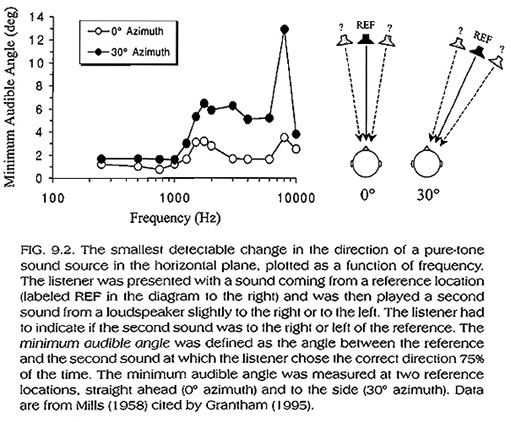
The minimum detectable interaural time
difference is 10microseconds or 0.000010s, corresponding to a shift
in sound source location by 10 in azimuth relative to
straight ahead (consistent with the minimum audible angle).
Explanation: Low frequency signals
with wavelengths that are large enough --compared to the average
listener's head-- to diffract efficiently, do not produce perceptible interaural level differences.
However, they do reach the two ears
at different times. For frequencies <500Hz, for example, the interaural time difference
is shorter than the signal's period and the entire head fits within
< half a wavelength. Consequently, at low frequencies, sound-source location produces unambiguous
and interpretable interaural phase differences or IPDs (save for
locations on the median plane, where IPD=0), because sounds will
arrive at each ear at a different phase within the same cycle.
The maximum possible interaural
time difference that can occur due to sonic energy travelling
around the head is ~0.0008s (assuming an average head half
circumference of ~0.28m and speed of sound = 345m/s).
For a sine signal to reliably take advantage of IPD cues, its
period must be >1.5 times this value
(>0.0012) so that the entire head can fit within <2/3 of
a cycle. IPDs are therefore reliable localization
cues for frequencies <700-800Hz. The highest frequency for which IPDs provide any cues is
~1,500Hz.
IPDs also provide useful
localization cues for
complex signals whose spectrum includes components with
frequencies <~750Hz.
For complex signals with no low-frequency content (or for
amplitude-modulated high-frequency-content
signals), IPDs remain
useful as long as several of the frequency components are
separated by (or as long as the modulation rate is) <~750Hz. In such cases,
the complex signal's
envelope (in Plack, 2005:178) will display amplitude fluctuations at rates <~750Hz and
the IPDs between the signal envelopes arriving in each ear will
provide interpretable localization cues.
At higher frequencies,
single-cycle IPDs do not provide useful localization cues
because they depend not only on sound source
location on the horizontal & median planes but also on frequency and,
most importantly, distance. Different sound source locations can
result in the same IPDs, while the same angular location in the localization
coordinate system may result in different IPDs, depending on distance.
|

In Plack, 2005: 176 |
Strongest separation in lateralization (i.e.
in virtual location inside the head) occurs
for IPDs = 1/4 cycle, corresponding to signals with:
Period T ~0.0032s/cycle (= 4 x "longest possible ITD" = 4 x 0.0008s) and
Frequency f ~315Hz (= 1/T = 1/0.0032).
Example:
Three
successive 300Hz tones are presented in stereo (must use
headphones - no onset difference)
_In the
first, the left channel
leads by 1/4 cycle;
_In the
second, the phase is the same across channels;
_In the third, the right channel leads by 1/4
cycle.
This arrangement results in signal lateralization that appears to move from
the left, to the middle, to the right, following the signals' IPD.
Listen to three stereo signals with the same phase relationships, as
above, at
100Hz and
8000Hz.
What types of lateralization do they result
in? Do you still get a clear sense
of motion?
Interaural phase difference of
exactly 1/2
cycle (1800) results in a wider stereo image rather than
in lateralization changes.
Example:
Two
successive 300Hz tones are presented in stereo
(must use headphones - no onset difference)
_In the first, both channels are in phase (i.e.
IPD = 00);
_In the second, there is a 1/2 cycle phase
difference
between channels (i.e. IPD = 1800).
|
|
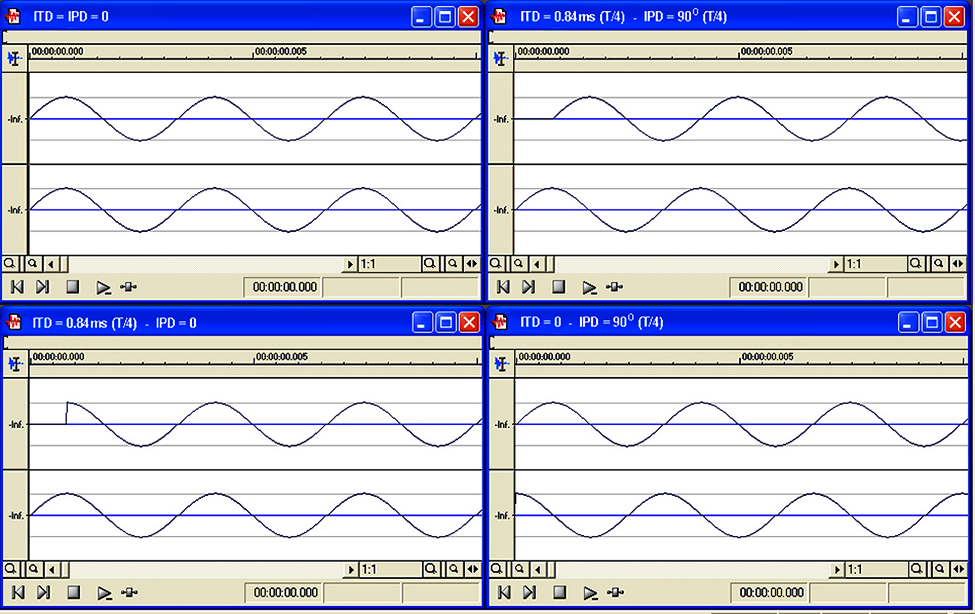
Interaural Time Difference (ITD)
vs. Interaural Phase Difference (IPD)
(must listen over
headphones)
* When IPD=0, the signal appears to come from the
center, regardless of whether
ITD=0 (top-left
graph) or
ITD≠0 (bottom-left
graph).
*
When IPD≠0, the signal appears to come from one side,
regardless of whether
ITD≠0 (top-right
graph) or
ITD=0
(bottom-right
graph)
In other words, apparent location of the sound source is
determined by the IPD rather than the ITD values.
ITDs
are relevant only in terms of the IPD values they impose.
|
INTERLUDE:
DICHOTIC BEATS
|
The phenomenon of
dichotic beats (often
inaccurately referred to as 'binaural beats') describes a
beating-like sensation arising when two signals with
slightly different frequencies are presented dichoticaly (i.e. one per
ear through headphones).
Contrary to the beating
sensations that accompany signals with amplitude
fluctuation rates <~15 fluctuations/sec.,
dichotic beats are not the result of periodic alterations
between constructive and destructive interference; dichotic
presentation does not permit physical interaction. Rather, they are the result of periodic
changes in IPDs and a direct
manifestation of our ability to detect the systematic IPD changes that, for low
frequencies, accompany sound-source motion. So,
the sensation of dichotic beats is based on our hearing mechanism's use of
static IPDs as sound-source localization cues and of dynamic IPDs as
sound-source
motion detection cues, at low frequencies.
Dichotic/binaural beats have acquired cult status,
with hundreds of websites and videos linking them to
a variety of
mental effects.
The apparent fascination is partially due to the disorienting
sensation elicited by this unnatural form of listening (dichotic
listening) and partially due to the coincidence between the most
salient dichotic beat rates and the frequencies of
some brain-waves (e.g. Theta and Delta
brain-waves).
For very small frequency differences (<~4Hz) between ears, the
resulting IPD modulations give rise to a "rotating" sensation inside the
head that can be easily identified as such (e.g.
Channel 1: 250Hz & Channel 2: 250.5Hz).
For larger frequency differences, (>~4Hz), the sensation does resemble
the loudness fluctuations (beating) that would result if
the tones in each ear were allowed to interfere, because the rotation
rate is faster than the hearing mechanism's ability to
follow it. However, this beating-like sensation is much less
pronounced than it would be if actual
interference had taken place (e.g.
Channel 1: 250Hz & Channel 2: 257Hz -
listen via headphones and via loudspeakers;
is there a perceptual difference?).
Dichotic and
interference-based beating sensations are manifestations of different physical, physiological, and perceptual phenomena.
(For additional information see
here
and
here)
|
Monaural
& Interaural Spectral Differences - HRTF / ATF
|
For sound
signals of intermediate frequencies (~ 500Hz<f<~1,500Hz), IID
and IPD cues do provide some useful
localization information, but only in the azimuth, and only if combined (IID
cues are perceivable down to ~500Hz and IPD cues are perceivable
up to ~1,500Hz).
For such frequencies, where IID and IPD cues are
ambiguous/unreliable in the azimuth, as well as for all frequencies in the case of sound-source elevation changes,
where IID=IPD=0, the auditory system relies on
monaural spectral cues and interaural
spectral difference cues.
Monaural spectral cues and interaural
spectral difference cues are due to the torso, head, and outer ear
performing azimuth- and, most importantly, elevation-dependent spectral
filtering on signals. This filtering 'colors' the spectral
composition of the signal arriving in each ear differently, depending on
sound-source location.
It is commonly referred to as Head Related Transfer Function or HRTF.
The more accurate Anatomic Transfer
Function or ATF captures the contribution
of parts of the body other than the head but is less
commonly used.
As is the case with most
sound source localization
cues, spectral cues are not foolproof. For example, in
the median plane, signals rich in high frequencies tend to be localized
higher than signals rich in low frequencies, even when the source
elevation remains the same.
At frequencies <~200Hz,
whose wavelengths
are larger than the dimensions of the structures involved
(head, torso, pinnae), interaural spectral differences and the associated HRTFs
do not provide useful localization cues at any orientation.
|
Interaural spectral differences
due specifically to structural differences between the pinnae
of the two ears contribute to better lateralization (i.e. more accurate
virtual location of the sound within the head), especially in
the elevation plane. Pinna-related
spectral filtering alone does not help us 'construct' a complete aural 'image'
of the outside world.
Experiments that apply HRTFs (ATFs) obtained from
dummy heads/torsos on the equalization and reproduction of
signals indicate that interaural spectral differences
due to the
entire torso/head/pinnae system contain information that helps us
perceive and reconstruct the actual
source location
outside the head.
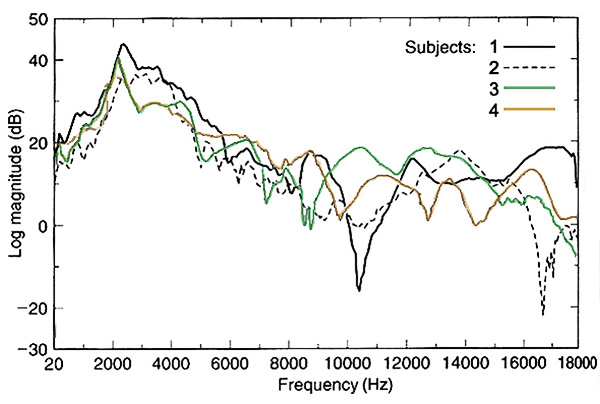
Head Related Transfer
Function (HRTF) is defined as the ratio of the sound
pressure spectrum measured at the eardrum to the sound
pressure spectrum that would exist at the same location
(i.e. at the eardrum or the center of the head) if the
listener was removed. The figure to the right displays HRTFs as a function of sound-source
elevation
angle. From this and other similar
datasets it has been inferred
that:
• The 8kHz region seems to correlate with overhead
perception (i.e. spectral changes in this region correlate with changes
in the perceived location of sound sources above our heads)
• Regions in the frequency bands 300-600Hz & 3000-6000Hz seem to correlate
with
frontal perception
• Regions centered at around 1200Hz & 12000Hz seem to correlate with rear
perception.
HRTFs are personalized, as they
depend on variable pinna, head, and torso
construction among individuals (e.g. data in the figure, below).
Consequently, spectral sound-source localization cues and the associated HRTFs are most likely learned through
experience, with individuals generally localizing better with
their own cues than with those of others.
At the same time, it has been
shown that physiological differences may result in some
listeners performing much better than others on auditory
localization tasks.
Imposing 'good' HRTFs (through
appropriately equalized headphone listening) on individuals who
have difficulty localizing sound sources can improve their localization
performance by providing more salient interaural spectral
differences, assuming comparable head size between 'donor' and
'recipient' and sufficient learning time.
 |
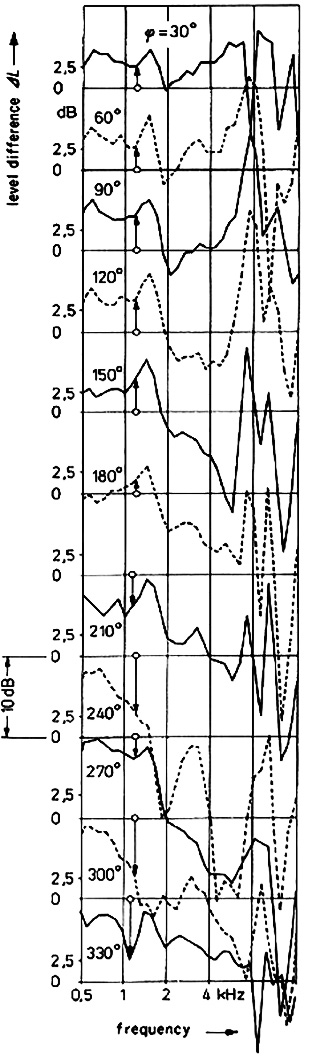 |
Experimental explorations of HRTFs/ATFs use
specially-designed binaural heads (e.g.
KEMAR,
by G.R.A.S. Sound & Vibration, Denmark) to record signals at
various positions in their path to the ear drum and tease
out the various anatomical spectral-filtering contributions.
 |
Binaural Cues & "Release from Masking"
|
IID
and IPD cues also help us perceive tones that would have otherwise been masked. The following
listening examples illustrate this point and correspond to the three scenarios described in the
figure to the right (must use headphones).
(A)
Example 1: a 300Hz sine signal with no IIDs
or IPDs is presented along
with a 600Hz-wide noise band, centered at 300Hz. Due to the level difference
between signal and noise (the signal is 15dB below the noise) the sine tone is masked.
(B)
Example 2: same as in (A) but with a 1800 IPD for the sine signal.
In spite of the level difference between noise and signal, the
sine tone is now perceivable.
(C)
Example 3: same as in (A) but with the left channel of the sine signal
removed (extreme case of IID for the sine signal). In spite of the
now increased level
difference between noise and signal, the sine tone is again perceivable.
In other words, a masked tone
can become audible by reducing its overall level.
[ signals
used for the audio examples:
Noise /
300Hz /
300Hz 1800 IPD /
300Hz no left channel ]
IPDs (for low
frequencies) and IIDs (for high frequencies) can reduce a signal's
detection threshold by up to ~15dB. The effect is less
salient for "IPD & high frequencies" and IIDs & low
frequencies" contexts (why?).
The release from masking of complex
signals is facilitated further by interaural spectral
differences.
The described release from
masking is not due to our ability to localize a signal thanks to the imposed
interaural differences. Rather, it is due to signal de-correlation between ears, supported by the
interaural changes and supporting the employment of cognitive
strategies (e.g. attention focusing) for signal detection
in complex sonic environments.
|

(in Plack, 2005: 180) |
Cone of
Confusion - Head-Movement Localization Cues
|
Cone of confusion
Sound sources moving on a sagittal plane
(i.e. changing in elevation) produce no IID or IPD changes and
only moderate interaural spectral difference changes.
Consequently, their movement is difficult to track by purely
auditory means. More generally, for any given IID or IPD value,
there will be a conical surface extending out of the ear that will
produce identical IIDs and IPDs, hindering sound source
localization over the surface (see to the right).
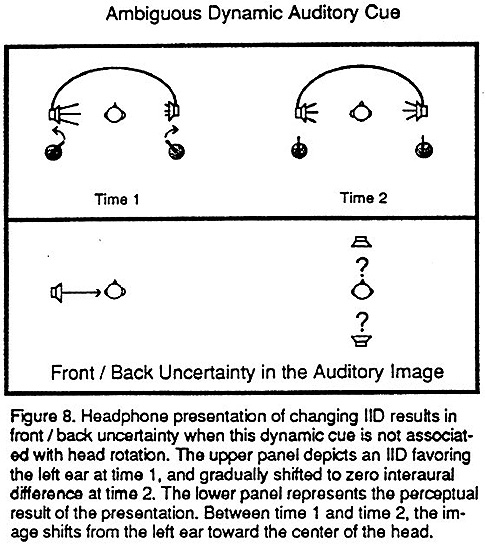
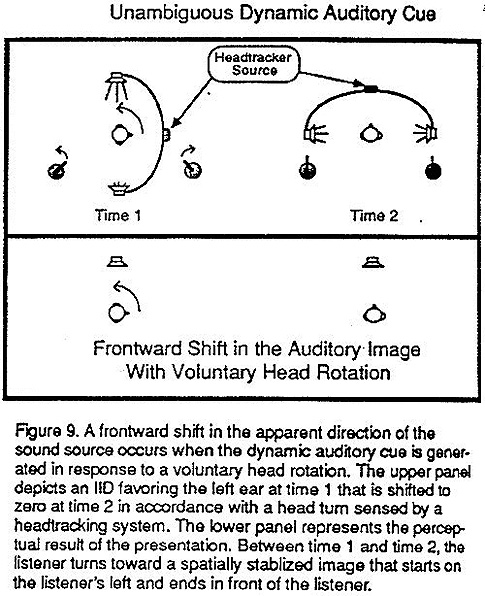
The most effective strategy in
resolving sound-source localization ambiguities is head movement,
assuming the sound signal lasts long enough, unchanged, to allow for
such a movement to be of use. Moving the head in the horizontal plane
can help resolve front-to-back ambiguities (e.g. see below-left), while head tilting can help resolve top-to-bottom
ambiguities.
Interaural
spectral differences and the associated HRTFs do help resolve
localization ambiguities, whether in the median sagittal plane or within
any cone of
confusion, but only partially.
As is the case with most sound-source
localization cues, the salience of head-movement cues depends largely upon long-term
learning and experience.
Auditory localization experiments using
headphones and conflicting source and head
movements exploit our
reliance on previous experience, resulting in revealing
illusions.
Explore the figures, below, and read
the explanations in the captions.
|
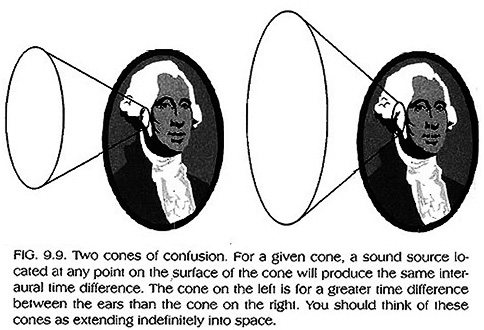
(in Plack, 2005: 184) |
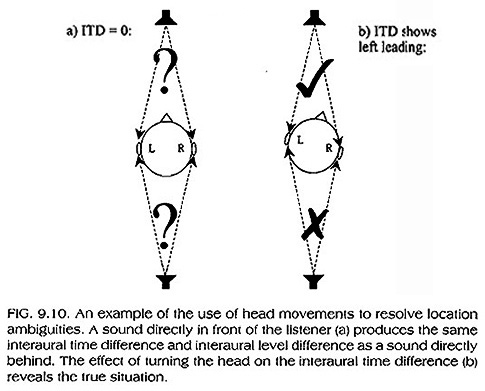
(in Plack, 2005: 185) |
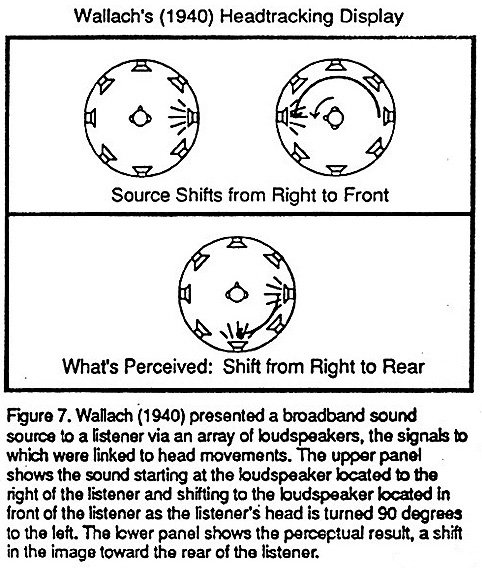 |
|
 |
 |
Judging Sound-Source Distance
|
Distance and loudness
Judging sound-source distance can be partially aided by loudness cues. In general, softer sounds are more likely to be associated with sources farther
away and louder sounds with sources
nearer.
Loudness cues are only reliable when
comparing the loudness of a sound to a known reference that precedes it
and/or when judging familiar sounds. In all other cases, loudness
cues cannot reliably support distance judgments.
Even in reliable contexts,
distance changes are underestimated when
judged based solely on loudness changes.
More specifically,
although distance doubling in the free field (i.e. where there are no
reflections) corresponds to an ~6dB SPL reduction, listeners require
an ~20dB SPL reduction in order to report that their distance to a
sound-source has doubled.
Distance and reverberation
In reflective environments, distance
judgments are aided by reverberation cues. In general, the greater the distance of the source the greater
the proportion of the reverberant (relative to the direct) sound.
Direct-to-reverberant-sound cues
provide coarse source-distance information and only become perceptible
for distance changes by a factor of two or larger. In
addition, distance-change judgments based on this cue alone tend, again,
to be underestimated.
Distance and spectral composition (timbre)
Changes in sound-source
distance are linked to timbral changes, mainly due to corresponding
changes in a sound's high-to-low frequency SPL ratio. In general, increasing the distance from a sound source
tends to reduce this ratio because air absorption reduces high frequencies
far more than low frequencies. This cue is most perceptible for large changes in distance.
In addition, the increased likelihood
of higher frequencies to be blocked by obstacles and of lower
frequencies to diffract around them further reduces a sound's
high-to-low frequency energy ratio with distance. Absorption (by
air) and blocking (by obstacles) of high frequency can therefore
explain the observation that low frequencies travel much further than high frequencies and, at very large distances, the level of high frequencies drops to 0.
NOTE
In the absence of obstacles and for short-to-middle distances
(~20-40m from a source, where air absorption is negligible), all
frequencies lose ~6dB SPL for each doubling in distance (why?)
and the high-to-low frequency SPL ratio remains fixed.
However:
A given change in dB corresponds to a larger loudness change
at low vs. high frequencies, as can be inferred from the
equal loudness contours (why?).
In the above scenario, increasing the distance from a source
will therefore reduce the loudness of low frequencies more than that
of high frequencies, even though the SPL of both frequency
ranges will be reduced by the same amount. In other words,
while the SPL ratio of high-to-low frequencies remains
fixed, their loudness ratio increases.
|
|
Sound-source distance and overall
location judgments based solely on aural cues are not precise and
require a combination of experience/familiarity with any given sound source
and with changes in context, loudness, reverberation, timbral,
and visual cues that may accompany changes in sound source location.
This is one of the reasons why,
for example, AI implementations of sound source localization cues to
self-driving vehicles had, until recently, failed. The most promising
approaches, based on neural networks and deep learning, employ the discussed sound-source
localization cues differently than human listeners.
See for example these studies:
_
Three-Dimensional Sound Source Localization for Unmanned Ground
Vehicles with a Self-Rotational Two-Microphone Array
_
Sound Source Localization of Cars at Intersections Based on Deep Learning
|
The Precedence Effect
|
The precedence effect describes a learned strategy employed implicitly
by listeners in order to address conflicting or ambiguous localization
cues occurring in environments where sound wave reflections play an
important role (e.g. all rooms other than anechoic environments).
This strategy is believed to develop through exposure to reverberant
listening contexts and is eventually applied automatically to all
listening contexts, leading to possible auditory localization
"illusions."
According to this effect, listeners
make their sound source localization judgments based on the earliest arriving
sound onset. The term "precedence" is used to indicate that the
direct sound, with presumably accurate localization information, is
given precedence over the subsequent reflections and reverberation,
which convey inaccurate localization information and blur the
sources aural "image." In fact,
in reflective/reverberant environments, both IPD and ILD cues may be
diffused to such an extent that they become unusable, making the
precedence effect a necessary localization strategy.
|
 |
The Haas effect (named after mid
20th century German psychoacoustician,
Helmut Haas), describes the observation that, for
arrival-times differences up to 30–40 milliseconds, the precedence
effect persists (i.e. listeners localize the sound source based
on the earlier arriving signal) even if the delayed signal is up to 12dB
stronger than the first (see the image, below, and
watch this
demonstration).
The Franssen effect (named after
mid 20th century Dutch physicist and inventor, Nico V. Franssen) describes the observation that, an intense,
fast-rising tone presented in a reverberant space via a single
speaker will continue to be perceived as originating from that
speaker even after it has gradually moved to a second loudspeaker,
45 degrees away.
The figure to the left illustrates a precedence
effect demonstration with two loudspeakers reproducing the same pulsed wave.
The pulse from the left speaker leads in the left ear by a few
microseconds, suggesting that the source is on the left. The pulse from the
right speaker leads in the right ear by a similar amount, which provides a
contradictory localization cue. Because the listener is closer to the left
speaker, the left pulse arrives sooner and wins the competition—the listener
perceives just a single pulse coming from the left.
From
"How we Localize
Sound" by American physicist, W. M. Hartmann; standard reference resource on
the topic of sound source localization.
[ Optional:
Watch Prof. Hartmann's 2018 presentation on the
state of sound source localization research at McGill University's
Center for
Interdisciplinary Research in Music Media and Technology. ]
|
|
The
figure, below, illustrates the interaction between interaural time & intensity differences, observed in experiments exploring the precedence effect.
-
For small delays (<~1ms) between ears (i.e. small differences
in the distance between a sound source and each ear), localization is biased towards the side producing the
louder sound.
-
For delays between 1-40ms, localization is biased
towards the
earlier sound.
-
For larger delays we hear two sounds, with the second
perceived as an echo of the first, even if the 'echo' is stronger than the
original.
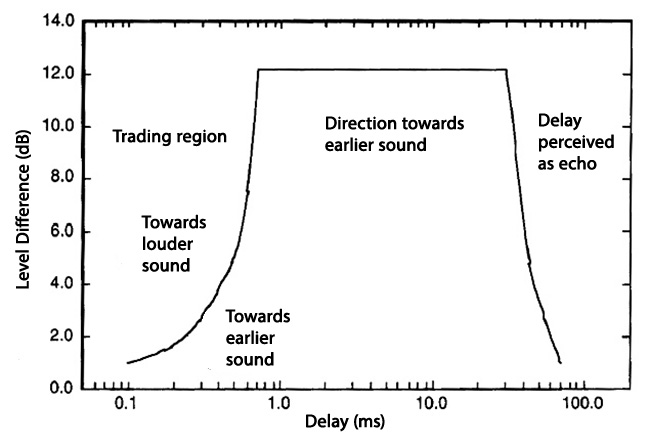
[Optional:
Brown et. al, 2015. The Precedence Effect in Sound
Localization.] |
|
OPTIONAL: Sound source localization neural mechanisms
|
|
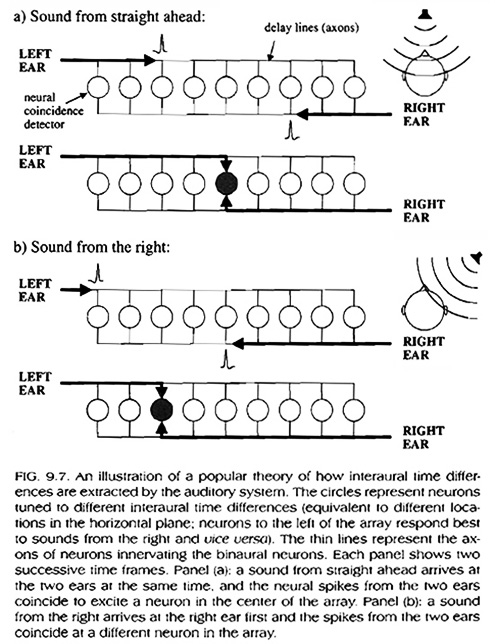
To explain ITD (IPD) detection, America psychologist,
Lloyd Jeffress hypothesized the presence of a coincidence detector, at the
neural level, that uses delay lines to compare arrival times at
each ear. His theory is illustrated in the figure,
below left (Jeffress, 1948, in Plack, 2005: 182).
Assuming the presence of neuron arrays, which are tuned to
different delays and encode signal arrival time differences
between ears, the Jeffress model is equivalent to cross-correlation, comparing the inputs from each ear at
different time delays [
video
explanation ].
|
 |

Jeffress's model has been partially confirmed by
physiological evidence from birds (e.g.
barn owl).
However, evidence from mammals (e.g. gerbil)
suggest broad sensitivity to interaural time
differences per characteristic frequency that corresponding to the period of that frequency
(see above; in Plack, 2005: 183).
This
observation fits to the already discussed observations
that
a) ITDs do not provide sound source localization at high
frequencies
(the Jeffress model cannot explain this) and
b) it
is a very special type of ITDs that is of importance: IPDs
(only up to 1/2-cycle IPDs are well represented by the gerbil
data).
[Advanced review in
Ashida & Carr, 2011]
|
IID detection can be explained
in terms of the associated difference between excitatory and
inhibitory activity in the two ears when stimulated by signals
that display IIDs (see
Park et al., 1996).
Explore this list of links to relevant publications by Prof. W. Hartmann
and his colleagues (Michigan State University).
|
Loyola Marymount University - School of Film &
Television