Module 3
Lecture Notes - Part 2
Assignment, Grading, and Discussion Guidelines
Communicating clear and detailed guidelines of a course's demands on and
expectations from the students directly correlates with student satisfaction
and performance in an online course (Ko, 2004; Rivera
et al., 2002; Palloff and Pratt, 2003). Additional contributing factors include course organization,
instructor availability and empathy, and instructor motivation and
enthusiasm. [Walvoord, B.E. (2007). "Enhancing student motivation," Presentation
at DePaul University's Teaching Learning and Assessment Seminar Series.]
A. Assignment Instructions
Assignment instructions example
(adapted from Peirce, 1998)
Sample instructions that need revision
"Write a 15-20 page research paper (typed, double-spaced, with 1-inch margins). Your paper should discuss in depth a topic covered briefly in one of the assigned chapters. Cite at least five sources, using APA documentation format. The paper is due the last day of class and is worth 30 percent of the course grade."
Revision suggestions
- Make clear that the writing task requires thinking, not information reporting. Ask students to support a position on a debatable issue, to summarize opposing views, to explain where both sides agree and disagree, to evaluate evidence for a claim, to evaluate a procedure, etc. Use verbs like "evaluate," "support a claim," "argue," "defend," "compare," "interpret," "decide," "recommend," or "propose." Use the language of your discipline.
- Suggest how the final paper could be organized into sections; show students the customs of your discipline.
- Set up a schedule and provide peer and instructor feedback at important steps: selecting a research topic, searching for material, planning, reviewing drafts, etc.
- Consider abandoning the long research assignment. In its place, use a sequence of shorter graded assignments or informal small-group tasks.
Writing style, grammar, and structure expectations
Regardless of discipline, topic, or focus, all assignments must expect and support student development of writing skills. The best sources for instructions communicating writing-style expectations are academic libraries and scholarly journals' "instructions for authors." Some suggestions:
- "Writing style and word usage," in The ACS Style Guide: A Manual for Authors and Editors, (2nd Ed.), edited by Janet S. Dodd.
- "Writing the academic paper," Dartmouth College, Hanover, NH
- "Writing a research paper," bullet points by the University of Wisconsin, Madison
- "Grammar & mechanics," at The Owl, Purdue University, W. Lafayette, IN (select the appropriate link from the menu to the right of the page)
- "Guide to grammar and writing," Capital Community College, Hartford, CT
- Journal of the Acoustical Society of America style guide
- Taylor & Francis Journals (basic author instructions from over two-hundred Journals)
Due dates and student time management
Self-paced? Not really.
Being self-paced is one of the principle attractions of online courses. However, this and other similar factors that draw students online often end up also being the factors that contribute to attrition (Carr, 2000, in Palloff and Pratt, 2003), as they require high degrees of self-motivation, dedication, and self-discipline that cannot always be assumed. Misunderstanding what "self-paced" means is a recipe for online-learning failure. Although online courses are self-paced in that they usually do not require students to participate in the course at pre-specified times and locations, good online courses structure and pace student learning.
Well-paced? Yes.
To effectively support learning, online courses must be structured around frequent and evenly spaced milestones (i.e. assignment-submission deadlines) that clearly communicate what needs to be done, by when, and at what reward/punishment. Each course module must include at least two deadline-driven, graded learning activities.
Online-course pacing and student time management may be further assisted by also attaching a suggested start date to each learning activity. Collaborative student activities that are monitored by the instructor provide the best contexts for the observation of start dates and the creation of well-paced online courses. We will be discussing such contexts in Module 4.
Finally, breaking down large assignments into smaller, easily manageable tasks and including time-to-completion estimates can provide additional support towards well-paced and consequently effective student learning and assessment.
Technical and submission expectations
The following assignment information must be explicitly (even if tediously) communicated to the students:
- list of computer skills assumed by the assignment
- reminder that students should anticipate possible technical difficulties and never wait until the last minute to submit assignments or other coursework; nongraded practice assignments provide a good context for ironing out such issues
- submission mode (e.g. via e-mail, Blackboard's Assignment Manager, etc.) file format (e.g. .doc, .docx, .rtf, .ppt, etc.), and file naming conventions (e.g. having every student's assignment arrive as "assignment1.doc" would not be helpful)
|
|
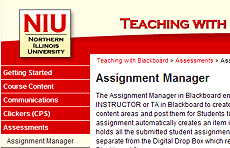
Using Blackboard's Assignment Manager has several advantages,
including Northern Illinois University has prepared a short guide to Blackboard's Assignment Manager. |
B. Assignment and Discussion Rubrics
As illustrated by DOTS and the courses reviewed so far, meaningful class
discussions are crucial to the success of an online course.
Common instructor errors with regards to online discussion
- Initiating discussions with questions that are too general and vague
- Providing minimal instructions and direction on how discussion should proceed
- Specifying minimal grading criteria or no grading criteria at all
Features of meaningful class discussions
- Like any other course assignment, discussions are tightly linked to course objectives and resources and are frequent and deadline driven
- They are supported by detailed and clear completion instructions
- They carry a grade component guided by detailed and clear grading criteria
Including appropriate grading criteria, or rubrics, significantly increases the number and depth of student discussion posts (Swan et al., 2007).
Creating successful discussion rubrics appears to often be a challenging task, usually because of problems in the design (i.e. fist two of the above features) of discussions.
Features of meaningful discussion posts
(adapted from Edelstein and Edwards, 2002)
Meaningful discussion posts
- are prompt and show initiative,
- exhibit correct spelling and grammar,
- are relevant to the discussion prompts,
- clearly express and support opinions, and
- engage with the rest of the discussants.
Discussion posts of the type "I agree" have none of these characteristics and should be explicitly discouraged. In addition, discussion rubrics should explicitly address student expectations regarding the instructor's degree of involvement in the discussions.
e.g. Will you respond to each post? Will you read all of the posts but only respond when there is a need to steer the discussion towards a different direction?
As we will see in Module 4, well-thought-out instructor involvement in online discussions plays a pivotal role in student learning.
Guidelines for effective rubrics
- Make all your expectations explicit
- Closely match grading criteria to the assignment instructions; assuming alignment between objectives and assignments, grading criteria should reference all learning objectives
- Clearly, succinctly, and consistently indicate what constitutes a good, an average, or a bad assignment
- Model good reasoning; encourage students to make their thinking "visible"
- Design criteria that support efficient grading and best use of your time
For the remainder of this section you will review a set of
discussion rubrics to identify features to adopt or avoid.
As is the case with all assignment rubrics, the main point to remember
can be summarized in the following statement:
Be specific and
consistent enough for students (or alternative graders) to be able to clearly
understand what you are looking for and general enough to address all
possibilities with as few tedious criteria as possible.
An example of a useful feature is the inclusion of "model responses."
An example of a less useful feature is the widely spread, rather tedious, and largely ineffective practice of counting posts (e.g. "each student must submit at least two original posts and one response to a classmate's post"). Some discussion rubrics (such as the Collaboration Instructions for Group Assignments in DOTS) include no such stipulation, thanks to assignment design and management features that we will be addressing during Module 4.
Sample discussion rubrics
- Sample grading rubric for the collaborative assignments in DOTS
- Collaboration rubric (San Diego State University, The Cabrillo Tidepool Study - a succinct and well-designed rubric)
- Online-discussion rubrics (Worcester Polytechnic Institute, Worcester, MA)
- Fourteen sample discussion rubrics (multiple sources)
Download for current and future reference.
Note: The discussion rubrics have been packaged into a single .zip file. Save this file on your computer and unzip it to access the fourteen rubrics (in nine .pdf files).
- Rubrics for the creation and evaluation of discussion questions by Burks Oakley, Professor Emeritus, Department of Electrical and Computer Engineering, University of Illinois, Springfield.
C. Course-Rubric-Creation Tool
Rubistar
is one of several online-learning tools created by 4Teaches.org, a
teaching-with-technology resource launched and maintained by ALTEC,
University of Kansas. |
|