Copyright and
Intellectual Property
Lack of Clear Legal Frameworks.
Copyright laws worldwide are designed to protect human creators and had not, until
recently,
explicitly addressed works created by AI. Most jurisdictions require
that a work be created by a human author to qualify for copyright
protection, which creates a legal gray area for AI-generated music.
In cases where AI-generated music is not considered "authored" by a
human, it falls outside the scope of traditional copyright
protection.
In March 2023 the US Copyright Office, Library of Congress, ruled that
AI-generated art cannot be copyrighted
because such work "...lacks human authorship
and the Office will not register it."
The ruling was updated in
August 2023. You can follow subsequent and eventual future updates
here.
Who Owns AI-Generated Music? Is it the developer of
the AI, the user who prompted the AI to generate the music, or the
entity that owns the dataset used to train the AI? If AI platforms
charge users, should they also be able to claim portion of the
rights for the music created by those buying their
service?
Different
stakeholders (e.g. AI developers, musicians, record labels)
may
claim ownership based on their roles in the creation process. Some
jurisdictions propose that the owner of the AI or the user who
inputs commands should own the copyright, while others suggest that
AI-generated works might enter the public domain.
Relevant
legislation has been in the making in the EU (The
EU Artificial Intelligence Act) and the US (COPIED
Act,
US Senate Committee on Commerce, Science, and Transportation),
with developments expected to continue for the foreseeable future.
Training Data and Derivative Works. AI systems are trained on
vast datasets of existing music, which includes copyrighted
material. If an AI model generates music that resembles or closely
mimics copyrighted works, it raises questions about
whether or not artists, record labels, and publishers can claim
infringement and whether the output constitutes a derivative
work. Determining the degree of similarity and originality is
a complex issue;
courts may need to establish new standards to address
it.
In June 2024,
several major music labels, represented by the Recording
Industry Association of America (RIAA),
filed ajoined lawsuit
against the Suno and Udio, two leading generative AI music creation services, alleging that they unlawfully trained their AI on the
labels’ copyrighted sound recordings.
UMG and WGM settled with both Udio and Suno in late 2025, with
Udio and UMG actually entering into a partnership.
Decisions on
remaining cases (e.g. with Sony) are pending.
Suno and Udio are eventually
expected to transition to licensed models,
requiring paid accounts for audio downloads and
securing greater artist rights and compensation.
Licensing and Royalties. In traditional music production,
licensing agreements dictate how royalties are distributed among
composers, performers, producers, and publishers. For AI-generated music,
licensing models are still evolving. Developers and users of AI
systems will likely require new forms of licensing agreements to
determine if/how royalties
should be shared among the creators of the works used to train the AI, AI
programmers, etc.).
ASCAP has been at the forefront of
the industry's ongoing efforts to address licensing issues
(see the FAQ section).
Even if
AI-generated music is not eligible for copyright
protection, the question of attribution remains.
Musicians, producers, and developers involved in
creating or using AI tools may seek recognition
for their contributions. Proper attribution
systems need to be developed to credit those who
play a role in the creation of AI-generated
music [ e.g.
US Copyright Office Guidance to The MLC
(Mechanical Licensing Collective) ].
Authorship and Creative Agency
Defining Authorship in the Age of AI. The concept of
authorship traditionally involves creativity, originality, and human
expression and agency. With AI-generated music, determining who the "author" is
becomes challenging.
If AI systems autonomously generate
music without direct human input or intervention, can the output be
said to have an "author" at all? This raises philosophical and
practical questions about the nature of creativity and AI's role as
a collaborator vs. merely a tool.
[ See
Caldwell, M. (2023). " What Is an “Author”? Copyright
Authorship of AI Art Through a Philosophical Lens." Huston Law
Review, 61(2). ]
Many AI-supported music
creation systems operate in a collaborative mode, where
humans provide input, direction, and feedback to guide the
AI. In such cases, authorship could be considered shared. Establishing clear guidelines for co-authorship
between humans and AI is crucial for recognizing human
contributions and safeguarding creative integrity [ e.g.
Pujari & Wilson, 2024;
Finell, 2024 ].
New Creative
Possibilities - Creation vs. Curation. Taking a more
optimistic angle, AI can assist in generating ideas, suggesting
harmonies, and creating accompaniments and novel sounds, freeing musicians to
focus on higher-level artistic decisions. Such a collaborative
dynamic supports experimentation and creativity in music
production, which, for some, is badly needed [ e.g. McEvoy, 2023 ].
The assumption is that musicians
themselves will engage in machine learning coding and
prompting, in recognition of the ability to effectively integrate
AI into the creative process as an essential
skill. Instead, we observe an exponential
increase of content volume, driven mainly by
automatically and artificially generated ...Muzak! [ e.g. Moore & Acharya, 2023 ].
With AI taking on more of the
creative process, the role of musicians may shift from traditional
creation to curation and customization. Musicians may focus
on selecting, refining, and enhancing
AI-generated content rather than composing from
scratch, redefining what it means to be a
composer/producer.
Ethical and Cultural Implications
Preserving Human Creativity and Diversity. There is concern that over-reliance on AI-generated music could homogenize
musical expression, leading to a lack of diversity in creative
output [ e.g.
Price, 2024 ].
Moreover, AI-generated content can degrade future AI
systems through model collapse: when new
models are trained on data produced by older models,
they gradually lose accuracy and grounding in
reality, becoming repetitive, distorted, or
nonsensical. As AI-created text and data
increasingly saturate the internet, they replace
authentic human sources and skew the training base [ e.g.
Shumaliov et al., 2024 ].
How can AI tools be designed differently in order to
support/enhance rather than
replace/flatten human creativity?
Is this the responsibility of the AI designers or of
the users? Ensuring that human artists retain (and
respect their) creative autonomy and agency while
collaborating with AI is a key consideration
[ e.g.
Spanu & Morris, 2025 ].
Devaluation and Job Displacement. AI-generated music could devalue human musicianship,
especially if AI-generated compositions become prevalent in
commercial applications like advertising, film scoring, and
streaming. The potential for job displacement for
session musicians, composers, and producers, is a significant
concern. The negative economic consequences, outlined above, are likely to continue in the
same direction, unless a new royalty framework is
instituted to protect human creativity in
AI-generated music [ e.g. Jacques & Flynn, 2024;
Mokotow-Pelczynski, 2024a;
Mokotow-Pelczynski, 2024b ].
Bias and Fairness in AI-Generated Music.
AI systems are only
as good as the data they are trained on. If trained on biased
datasets, AI-generated music could reinforce stereotypes or exclude
certain genres, styles, or cultural expressions [ e.g. Clair, 2024 ]. Consequently, understanding and
addressing bias in AI music models is both a
technical challenge and a cultural obligation.
Training generative AI models to honor the rich
diversity of musical expression will prevent biased
or narrow outputs in music generation and
recommendation systems while contributing to a rich
and diverse cultural narrative.
Impact on Music Education and Heritage. AI-generated music may
influence how future generations perceive music education,
creativity, and heritage. Balancing the use of AI tools with
traditional music education that emphasizes human creativity and
performance,
emotional expression, and cultural context is crucial. The relevant
challenges and opportunities have been noted [ e.g. Sánchez-Jara
et al., 2024 ] and the music
education community appears optimistic about the
outlook [ e.g. Zhang
et al., 2024;
Donaldson, 2024 ].
Music Industry Regulatory Considerations.
In order to maintain trust and integrity, the music
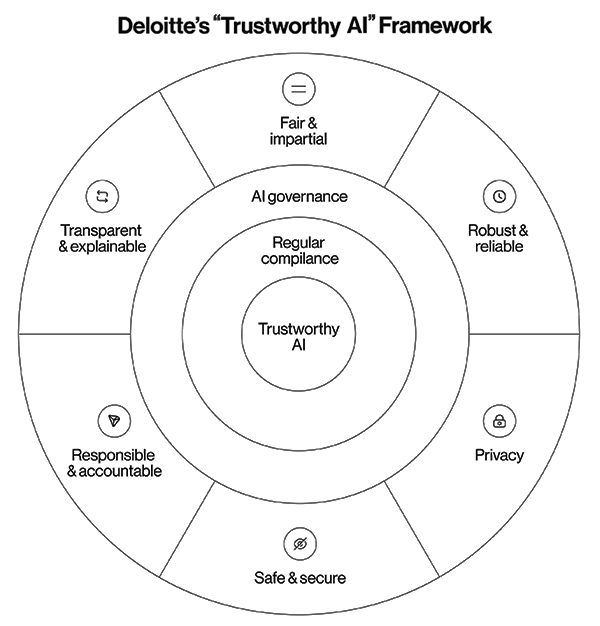
industry must grapple with transparency,
consent, and accountability. Listeners and artists have a right to
know whether a piece of music was created or co-created by AI and to
what extent (transparency) and must have the opportunity to allow or
deny the use of their creative work in AI training
(consent), while AI developers and users must be
liable for any transparency and consent violations
(accountability). Several organizations have
addressed the issue, including:
_OECD.AI: AI
Policy Observatory of the Organization for Economic
Cooperation & Development [ e.g. Ogul, 2024 ];
_12 artist organizations cosigning an
open letter to policy makers on artificial
intelligence published by CISAC;
_The
Human Artistry Campaign, a
global initiative backed by >150 societies
representing music writers &
performers.
_The
Music Fairness Action, a coalition of >300
artists calling on Congress to get artists paid for
AM/FM radio plays.